Hacking brings experts together
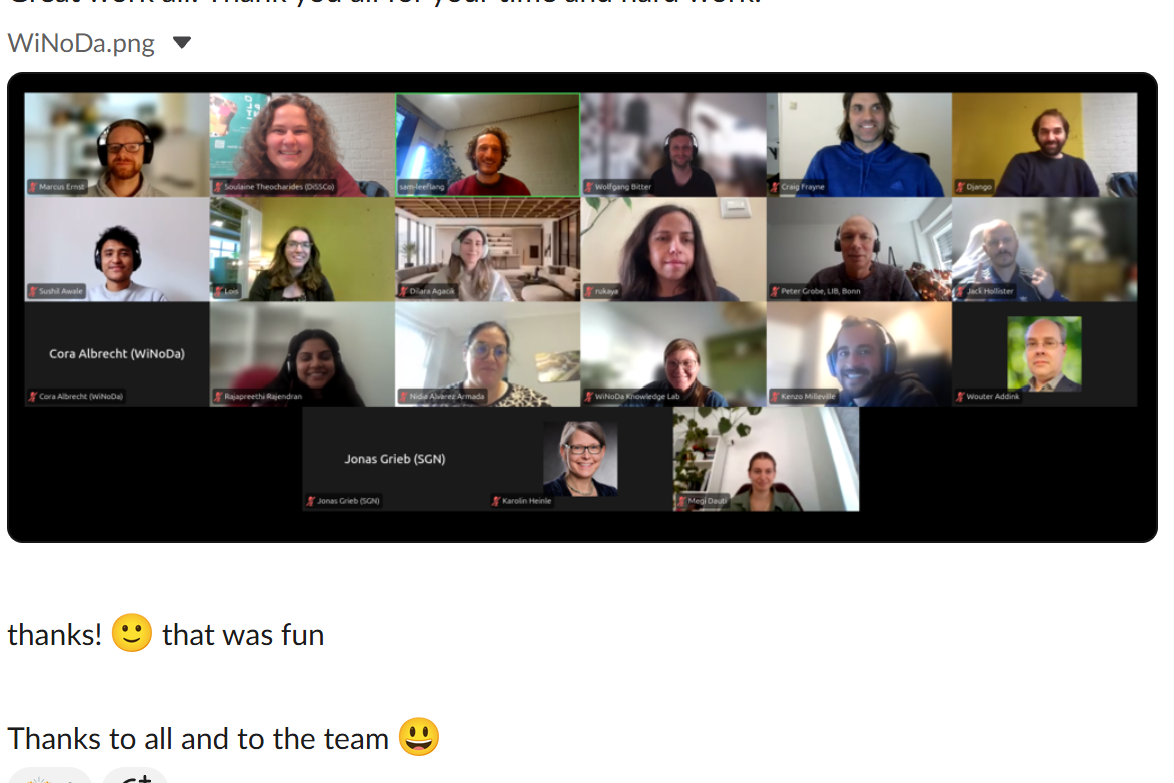
An online hackathon took place on 14–15 October 2026, in collaboration between WiNoDa and DiSSCo DiSSCo (The Distributed System of Scientific Collections). Under the theme ‘Advancing Specimen Data’, experts from the fields of bioinformatics, data curation and software development came together to develop new Machine Annotation Services (MAS) for the DiSSCo infrastructure. GFBio supported the event by drawing on its experience in organising and running online events such as the Winter School and RDMO Hackathon.
Technical support for success
The DiSSCoTech-Team DiSSCoTech-Team, based at the Naturalis Biodiversity Centre (Leiden, Netherlands), took charge of the technical support of the hackathon. The event centred on the development of MAS for integration into the DiSSCo infrastructure. Following a kick-off in mid-September, during which the key resources were presented and the first teams were formed, the main event took place over two days in mid-October. After a technical onboarding session and an introduction to the DiSSCo infrastructure, the final teams were formed and work could continue on several small projects until the following day.
Different use cases, innovative solutions
Over the course of two intensive days, six teams developed various machine annotation services designed specifically to enrich image-based collection data.
BDQ-Validator
- The team expanded an existing data quality framework to include geographical and taxonomic categories, enabling datasets to be validated automatically.
AIdentify
- AIdentify helps to identify the AI model being used and assists, for example, with pre-processing.
TraitTrail
- Based on image data, it provides suggestions for various morphological characteristics of pinned insects, such as wings, antennae, etc. The MAS converts the results into structured DiSSCo annotations.
Ruler Detection
- This tool locates the scale bar on digitised herbarium specimens and adds the image pixels in centimetres.
Verifying Herbarium Specimen
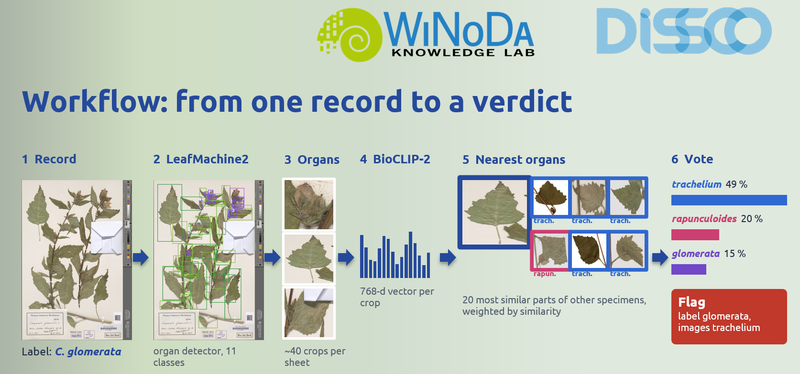
- This team developed a plausibility-checking workflow that compares the image file with the corresponding label. If the two differ too greatly, the system flags the need for a manual check.
Geographic Place Names
- This team tackled the challenge of historical and ambiguous place names. The MAS cross-references collection site data with modern geodatabases and clarifies historical geographical contexts, which can significantly improve the quality of distribution maps.
Plant Organ-Level Retrieval
- Closely linked to feature extraction, this team developed a search function at the organ level. Instead of searching only for entire specimens, users can now find and compare specific parts (e.g. ‘all leaves of this shape’) across the entire dataset.
Prototypes as inspiration
All of the developments are prototypes that participants can continue to work on after the hackathon. The WiNoDa Helpdesk and the DiSSCoTech team remain available to answer questions. The results and feedback will be incorporated into the further development of the DiSSCo infrastructure, as well as into the further development of interactive online formats at GFBio e.V.